
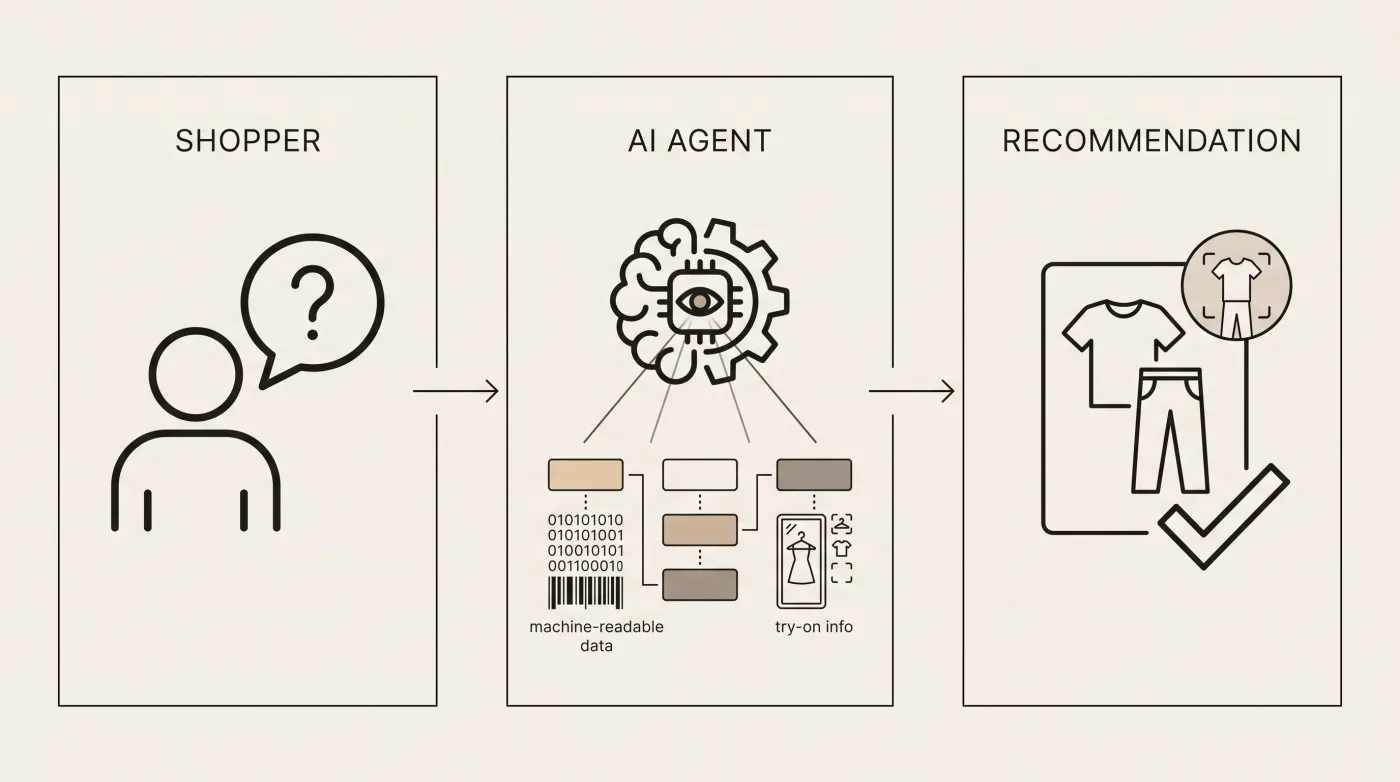
Two shifts are reshaping ecommerce at the same time, and both land squarely on virtual try-on. First, the shopper is increasingly an AI agent — ChatGPT, Google's AI Mode, Copilot and Perplexity now discover, compare, and in some cases check out on a person's behalf. Second, try-on itself is moving into those AI surfaces: Google will now render a garment on your own body from a single photo, inside search. If you sell fashion online, the ground your product page stands on is moving. Here's what's actually happening and what it means for your store.
The buyer is becoming an agent
Agentic commerce went from concept to infrastructure fast. Stripe and OpenAI shipped the Agentic Commerce Protocol and ChatGPT Instant Checkout in late 2025; Google followed with its own open standard co-developed with Shopify, Etsy, Wayfair, Target and Walmart and endorsed across the payments industry. Shopify's Agentic Storefronts now syndicate eligible merchants' products to ChatGPT, Google AI Mode, Microsoft Copilot and Perplexity at once.
The implication is simple and large: a growing share of "shopping" happens before a human ever loads your product page. An agent reads your catalog, compares it to competitors, and surfaces a shortlist — or buys outright. The storefront isn't disappearing, but it's no longer the only place the decision gets made.
Try-on is moving into search itself
At the same time, the most consequential virtual try-on launch of the last year wasn't from a try-on vendor — it was from Google. Google's AI Mode try-on lets a shopper upload one photo and see a garment rendered on their own body — not a generic model, not a live camera overlay. It runs on Gemini, currently covers shoes, tops, bottoms and dresses, and works across billions of listings.
If you've read our AI Swap explainer, this is the same core idea — AI photo-swap — now operating at platform scale. Which raises the obvious founder question: if Google gives away try-on, why would a merchant run their own?
Where branded try-on still wins (the three-layer reality)
The honest answer isn't "Google kills try-on vendors." It's that try-on is splitting into layers, and each serves a different job:
- Mass-market discovery (Google/AI): generic, commodity try-on inside search. Great for reach; you don't control the experience, the categories, or the data.
- The confidence-data layer: the reason try-on works — removing "will this actually look right on me" doubt — is exactly the signal agents need to recommend confidently. In an agentic world, your fit and visual-confidence data becomes merchant infrastructure, not just a UX nicety.
- Branded, on-store try-on (specialist vendors): the experience customers get on your storefront and in your brand, across every category you sell (not just what Google supports), with the analytics and merchandising control that platform try-on will never hand you.
Google offering try-on isn't a threat to that third layer — it's validation that try-on is now table stakes. The stores that win are the ones present in all three: discoverable by agents, rich in confidence data, and differentiated on their own site.
What this means for merchants, practically
Three things move from "nice to have" to "do this now":
1. Be legible to agents
If an AI can't parse your store, it can't recommend it. That means clean product feeds, structured data, and machine-readable content — the discipline often called GEO (generative engine optimization). Getting into Shopify's Agentic Storefronts and keeping your feeds accurate is the new shelf placement.
2. Treat visual confidence as data, not decoration
Virtual try-on's job has always been to cut the uncertainty that drives returns — see how virtual try-on reduces returns. In an agentic world that same signal does double duty: it lowers your return rate and it's the kind of confidence data that makes your products safer for an agent to recommend. Measure it (analytics guide) so you can prove it.
3. Own the on-store experience
Platform try-on is generic by design. Your own branded try-on — across eyewear, watches, jewelry, clothing and shoes, on Shopify or any platform — is where you control the brand, cover the categories Google doesn't, and keep the data. It's the difference between being a listing and being a store.
The takeaway
Agentic commerce doesn't make virtual try-on less relevant — it raises the stakes. The shopping decision is moving to a mix of AI surfaces and your storefront, and the merchants who thrive will be the ones an agent can find and trust, backed by real visual-confidence data, with an on-brand try-on experience the platforms can't replicate. If you want the full map of how try-on fits your catalog and platform, start with The Complete Guide to Virtual Try-On in Ecommerce.
Frequently asked questions
Will Google's free try-on replace try-on apps? No — it commoditizes basic try-on inside search but doesn't cover every category, doesn't run on your storefront, and doesn't give you the experience, branding, or data control. It makes try-on table stakes rather than optional.
What is agentic commerce? Shopping where an AI agent (ChatGPT, Google AI Mode, Copilot, Perplexity) discovers, compares, and sometimes checks out on the shopper's behalf, via open standards like the Agentic Commerce Protocol and Google's UCP.
How do I get my store ready for AI shopping? Keep product feeds and structured data clean so agents can parse you, get into agentic storefronts, and keep visual-confidence signals (like try-on and accurate fit data) strong.
Want branded virtual try-on that works on your storefront and across every category? Start free with TryOn Virtual — real-time AR and AI photo-swap, live on your product pages in minutes.
This article is part of The Complete Guide to Virtual Try-On in Ecommerce — our full breakdown of try-on types, product categories, ROI, and platform options.